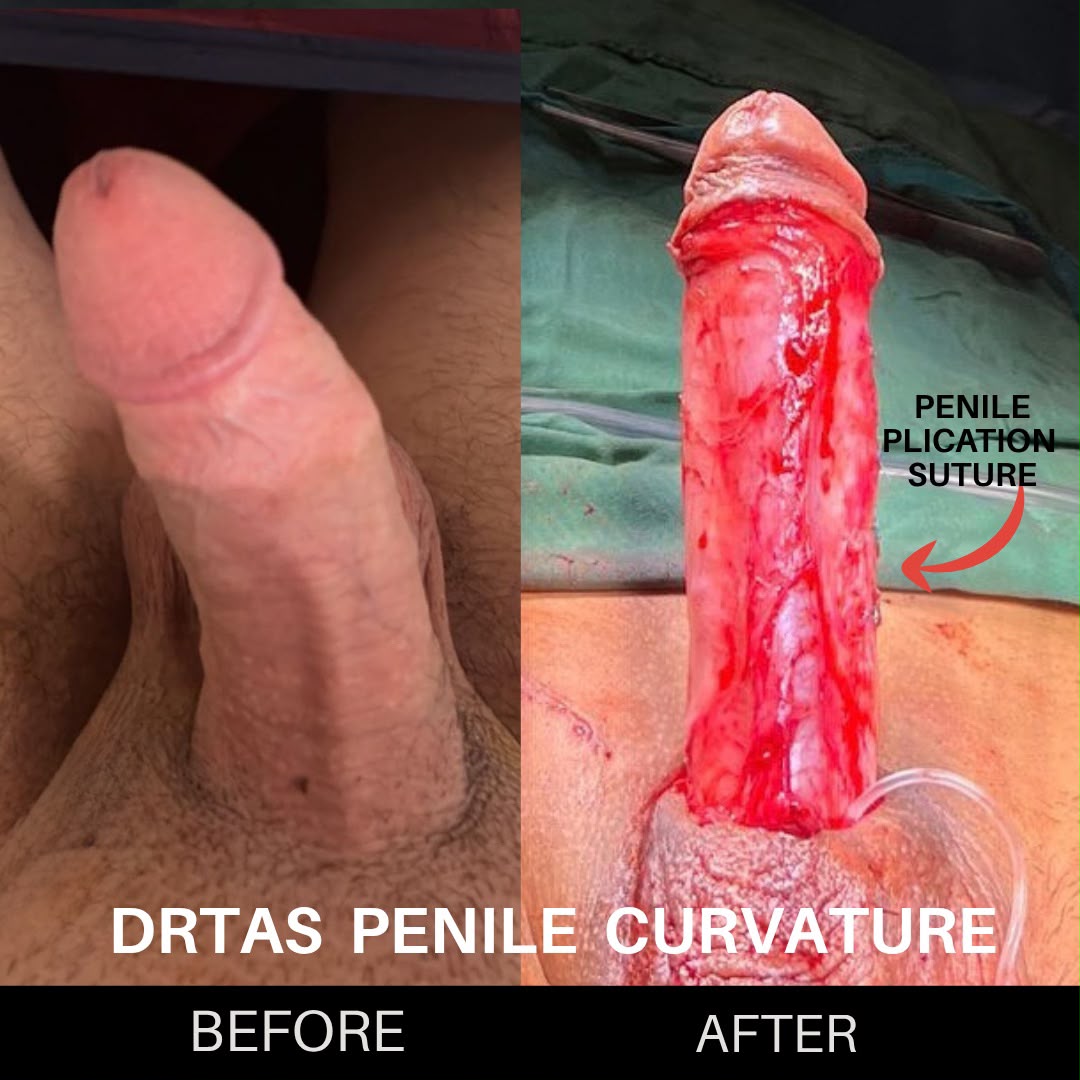
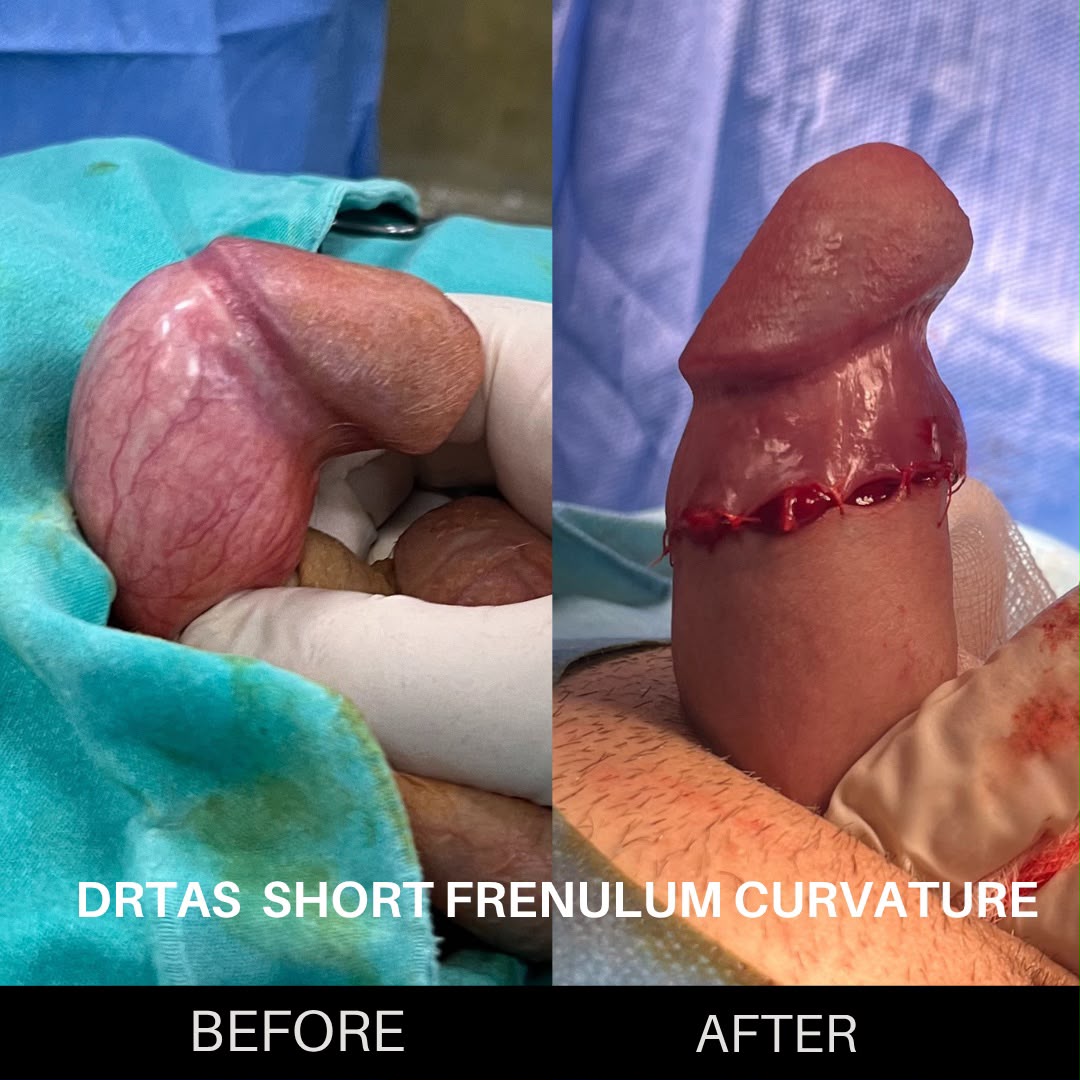
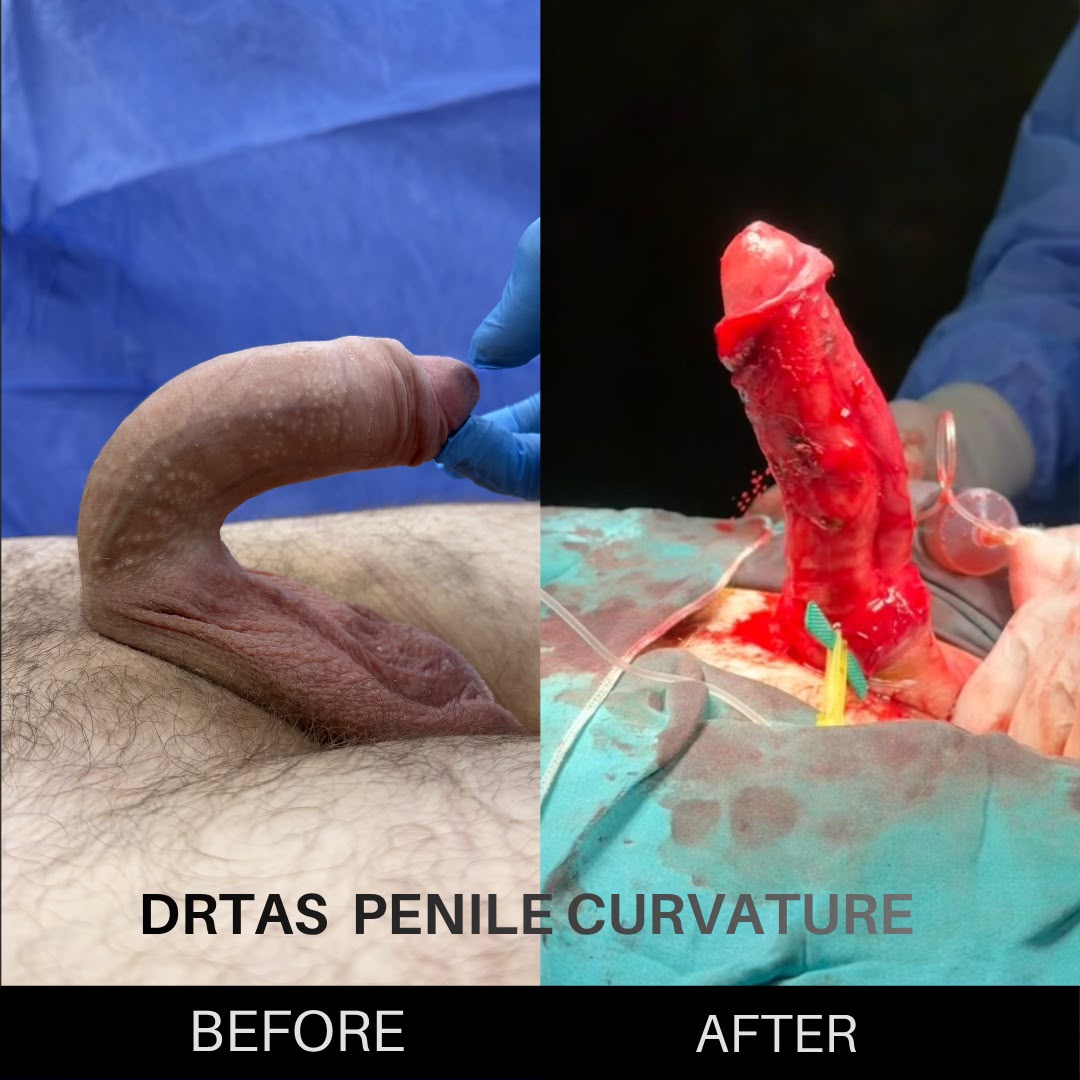
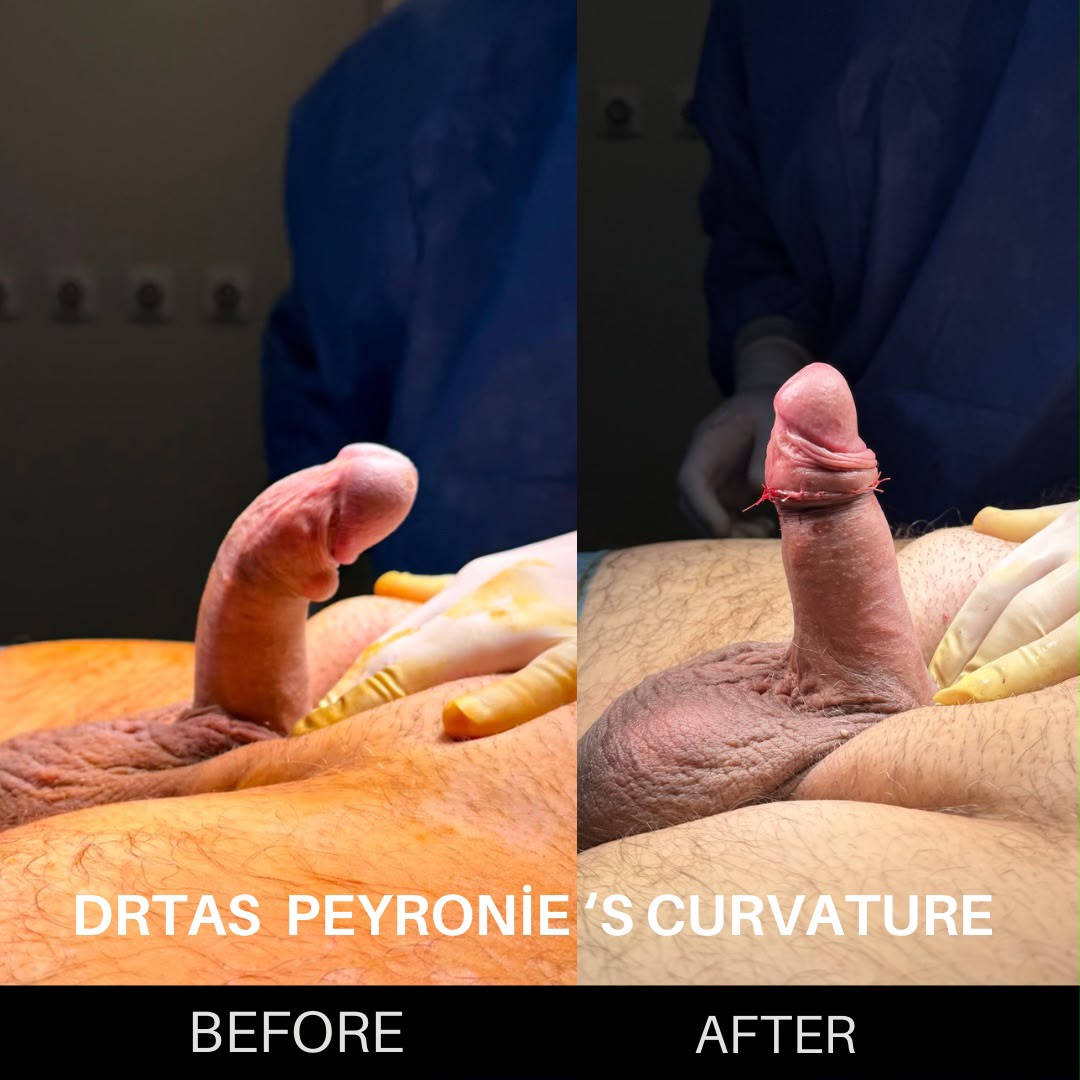
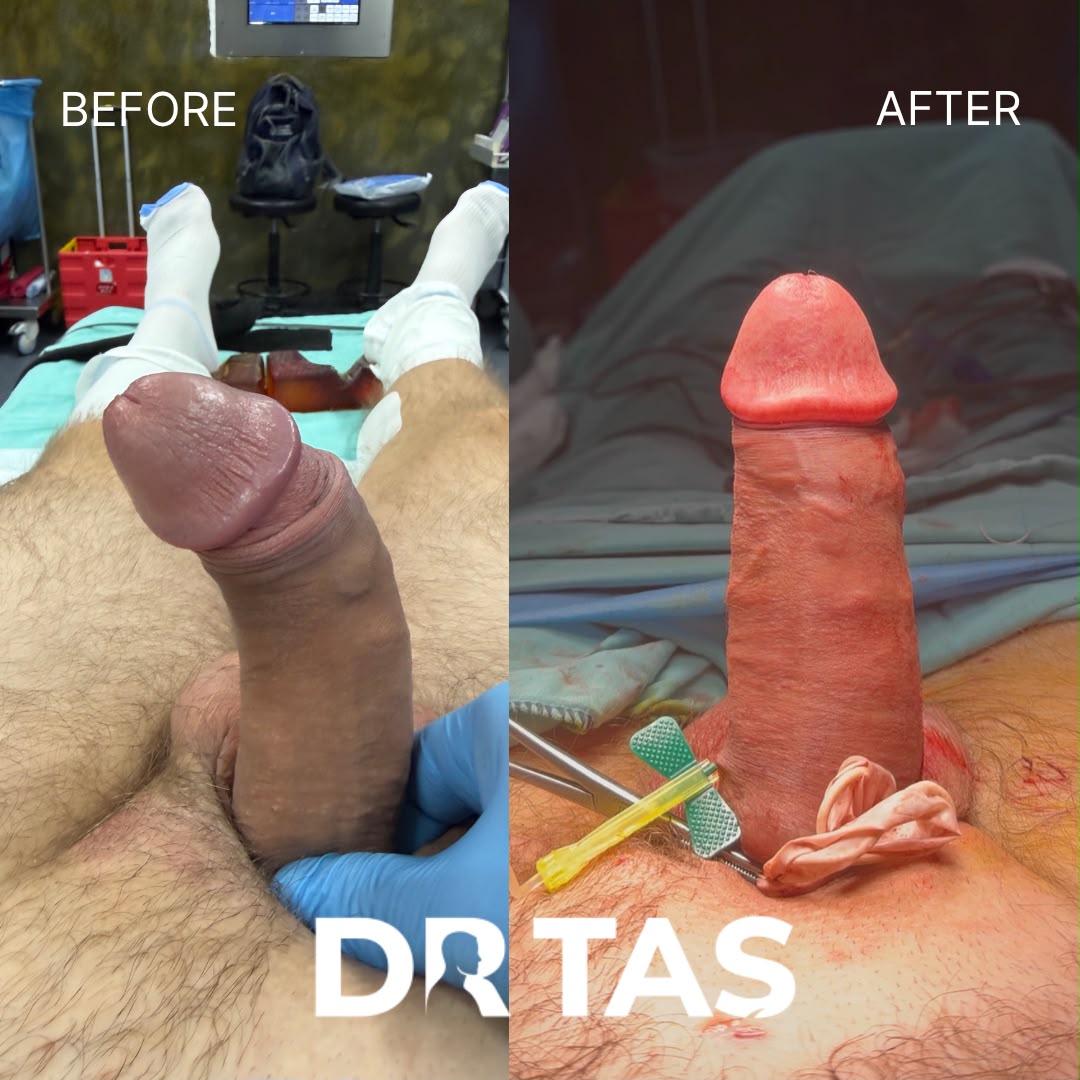
Penile curvature before and after photos from correction surgeries performed by Dr. Tuncay Tas in Istanbul. Outcomes shown here include results from congenital curvature and Peyronie’s disease treatment cases.
Both frames are taken erect, because a curve exists only under erection and a flaccid photograph would show nothing measurable. The angle in the before image is what selects the operation: a uniplanar bend of 30 to 60 degrees is plication territory, while curves beyond 60 degrees, along with hourglass and hinge deformities, point to plaque incision and grafting. Curvature correction is judged on the residual angle in the after frame, and the technique is chosen by Dr. Tuncay Tas only after the plaque has been mapped and the angle measured.
The clinical target is a shaft that functions, not an image with no bend left in it. Using a stepwise approach, including manual modelling against the inflated cylinders in implant cases, only 0 to 5 percent of patients are left with a residual curve above 20 to 30 degrees, and a bend below that mark rarely interferes with intercourse. Plication also shortens the longer side, typically by 0.5 to 2 cm for a 45 degree curve. That trade is worth understanding before you compare any two photographs.
The gallery contains both, and they behave differently. A congenital curve has been present since puberty, carries no plaque and no pain, and is usually corrected once it passes 30 degrees. Peyronie’s disease appears later, forms a plaque, often starts with pain and can keep changing for months. That difference decides the timing: a congenital curve can be operated whenever the patient chooses, while Peyronie’s is operated only after the angle has held steady. During the active phase, Xiaflex injection and low intensity shock wave therapy come first.
On an erection, either during examination or from photographs taken at home under standard instructions, alongside mapping of the plaque. That number then drives the plan: a uniplanar bend of 30 to 60 degrees points to plication, while an angle above 60 degrees, or an hourglass or hinge deformity, points to incision and grafting.
It depends on the technique. Plication works by shortening the longer side, which for a 45 degree curve typically costs 0.5 to 2 cm. Grafting preserves length but is technically more demanding and is reserved for severe or complex deformities. A penile implant with simultaneous straightening can preserve or even modestly extend length.
Plication and grafting correct the deformity present on the day of surgery; they do not switch off the underlying disease. That is precisely why European guidance is to wait until the pain has resolved and the angle has stayed unchanged for three to six months. Operating into an active phase is what risks a fresh curve forming.
Sometimes, within a narrow indication. Both the American and European guidelines restrict collagenase to stable disease with a dorsal or lateral curve between 30 and 90 degrees and intact erections. In the IMPRESS trials it produced a mean improvement of about 34 percent, roughly 17 degrees, against 18 percent on placebo. That helps a moderate curve and will not straighten a severe one, where surgical correction remains the option.
They are treated in one operation. An implant is placed and the shaft straightened at the same time, with residual curve corrected by modelling against the inflated cylinders and, if needed, plication over the implant. Straightening alone would leave a man with a straight but still unreliable erection.