
Medically reviewed by Assoc. Prof. Dr. Tuncay Taş
A buried penis is a functional problem before it is an appearance problem: it blocks hygiene, sprays urine and causes repeated skin infection. Reconstruction reverses that. In the largest recent outcome series, 90.3% of men were satisfied at a median of 46 months, 96.8% reported better genital hygiene and median exposed length rose from 7 cm to 11.3 cm. Assoc. Prof. Dr. Tuncay Taş plans each repair around the cause of the burial, whether that is a fat apron, scarred skin or scrotal tissue. Every consultation stays confidential.
Free Consultation
Our team responds within one business day, personally and confidentially.
Four numbers that set realistic expectations, taken from the two largest recent outcome series rather than from marketing copy.
Overall patient satisfaction after buried penis reconstruction, in a 46 patient series followed for a median of 46 months.
Life, 2024
Reported improvement in genital hygiene after repair. Every patient who answered reported better urinary function, and the median urinary symptom score fell from 10.0 to 3.0.
Life, 2024
Revision rate for a poor outcome across 103 high-complexity reconstructions, at a median follow-up of 11 months.
The Journal of Urology, 2023
Share of patients who were obese in the reconstruction series, and median BMI was 43 in the American high-complexity group. Weight is the dominant driver.
Life, 2024 · J Urol, 2023
“The modern approach to complex buried penis reconstruction results in a low revision rate; however, low-grade complications are frequent.”
Staniorski et al., The Journal of Urology, 2023 · 103 high-complexity repairs
Every figure on this page is attributed to the published series named beside it. These are group results from specialist centres, not promises: outcomes vary with the cause of the burial, body weight, diabetes control and general fitness for surgery.
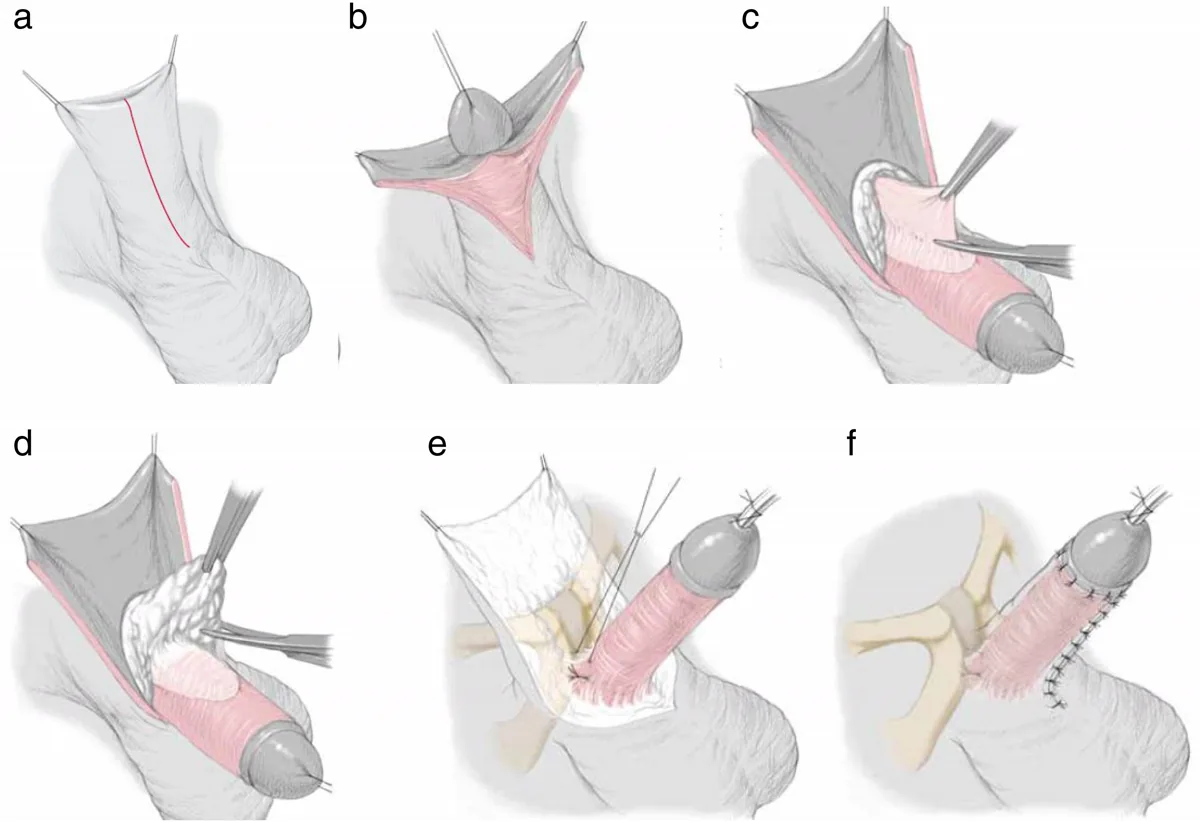
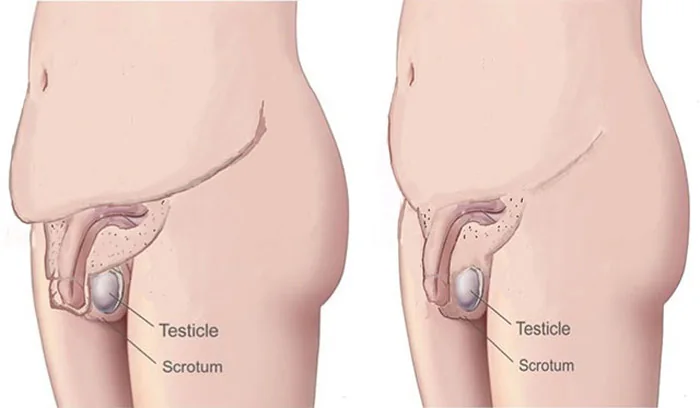
A buried penis is a penis of normal size that has become hidden beneath the surrounding tissue: a suprapubic fat pad, an overhanging abdominal apron, a high or webbed scrotum, or a ring of scarred skin. The shaft itself is usually intact. What has changed is everything around it.
Men rarely come in asking about appearance. They come in because they cannot keep the area clean, because urine sprays or soaks into the surrounding skin instead of leaving the body cleanly, because the skin keeps getting infected, or because penetrative sex has become difficult or impossible. In the 46 patient series published in Life in 2024, the median urinary symptom score before surgery was 10.0 on the IPSS scale and fell to 3.0 afterwards, while the median IIEF-15 sexual function score rose from 31.0 to 57.0.
The adult form is usually acquired rather than congenital, and it clusters with a small number of causes:
Identifying which of these is doing the burying matters, because it decides the operation. Fat requires removal of the fat pad; scarred skin requires excision and resurfacing; a high scrotum requires scrotal correction. Most men need more than one of these in a single procedure.
Buried penis repair is not a single named operation. It is a set of steps combined to match the cause, which is why published series report a range of complexity rather than one procedure.
The first step is freeing the penis from the tissue holding it down. Scarred or lichenified skin is excised, and where the shaft has been tethered to the pubis the attachments are divided so the full length can be brought out. This is the step that produces the visible change in length: median exposed length in the 2024 series measured 7 cm before surgery and 11.3 cm afterwards.
Nothing is added and nothing is lengthened. The operation recovers penis that was already there.
Where a suprapubic fat pad or an overhanging apron is doing the burying, that tissue is removed rather than merely lifted. Removing it is what stops the penis sliding back in. A panniculectomy was part of 28% of repairs in the 103 patient American series.
This is also the step most closely tied to weight. Where the fat pad reforms, the burial can return, which is why recurrence in the 2024 series reached 21.7% over a median 46 months and why weight stability is treated as part of the operation rather than advice given afterwards.
Long-standing burial often destroys the penile skin, leaving nothing healthy to close over the released shaft. In that situation the shaft is resurfaced with a split-thickness skin graft taken from the thigh. A graft was required in 63% of patients in the 2024 series.
Graft take is the step patients worry about most, and it is more reliable than expected: the median take was 95% for split-thickness grafts against 90% for full-thickness, with complete graft loss in 3.4%.
A high-riding or webbed scrotum can bury the shaft on its own, or undo an otherwise good repair by climbing back over it. Where that is the case the excess scrotal tissue is reduced and the scrotal attachment repositioned lower on the shaft.
It is a small step in isolation and a decisive one in combination, because it holds the result achieved by the other stages.
This operation asks more of the tissue than most andrology procedures, and the published complication rates reflect that. It is worth reading them before you decide rather than afterwards.
In the 46 patient series, complications occurred in 32.6% of men and 13.3% were Clavien grade III or above, meaning they needed a further procedure. In the larger 103 patient high-complexity group reported in The Journal of Urology, half the patients had a complication, but 41% of those were Clavien I or II, the kind managed with dressings and antibiotics. Wound dehiscence occurred in 31% and infection in 30%.
“The modern approach to complex buried penis reconstruction results in a low revision rate; however, low-grade complications are frequent.”
Staniorski et al., The Journal of Urology, 2023
The number that matters most sits alongside those: revision for a genuinely poor outcome was needed in only 3.9%. Most complications are wound problems that heal with time and care rather than failures of the repair.
Fitness for surgery moves the odds considerably. Frail patients in the American series were about six times more likely to have a complication than non-frail patients, which is why weight, diabetes control and smoking are addressed before the date is set rather than after.
Set against that risk profile is what the same patients reported once they had healed. In the 46 patient series, 93.5% said the operation had a positive effect on their quality of life and 93.5% would recommend it to another man in the same position. Median sexual function on the IIEF-15 scale rose from 31.0 before surgery to 57.0 afterwards.
One figure is deliberately lower than the rest, and it belongs in an honest account: sexual life improved for 66.7%, against 100% for urination and 96.8% for hygiene. Cleaning and passing urine respond to this operation more reliably than sexual function does. Where erectile function is the main complaint rather than the burial itself, that is a separate problem with a separate answer, and it is assessed as such at the consultation rather than folded into the same promise.
Buried penis repair is rarely covered by North American insurance, which classes it as cosmetic despite its functional purpose, so most men face the full cost themselves. In Istanbul the same reconstruction, including escutcheonectomy and grafting where needed, costs a fraction of the American or Canadian price, and the quote is all inclusive rather than assembled from separate surgeon, anaesthetist and facility bills. Waiting lists are measured in days. Istanbul is a direct flight from most major North American cities, and the seven to ten day stay this operation needs is arranged around you, with English speaking coordination, hospital accommodation and transfers included.
Reconstructive genital surgery rewards volume. Istanbul combines high case numbers, accredited hospitals and a cost structure that puts the operation within reach for men paying privately.
Many men delay this operation for years, either because they were told it was cosmetic or because they did not know it could be fixed at all. Istanbul offers reconstructive urology of an international standard in a setting built around visiting patients.
Where erectile function has also been lost, a penile implant can be planned alongside or after the reconstruction, and men whose main concern is size rather than burial should read about penile enlargement instead. The consultation establishes which of these actually applies.
It is reconstructive rather than cosmetic. A buried penis obstructs hygiene, sprays or obstructs urine and causes repeated skin infection, and those are the reasons men present.
In the 46 patient series published in Life in 2024, every patient who answered the questionnaire reported improved urinary function after repair, 96.8% reported better genital hygiene, and the median urinary symptom score fell from 10.0 to 3.0. Appearance improves as a consequence of fixing the function, not as the goal.
Satisfaction is high in the published series. Falcone and colleagues reported 90.3% overall patient satisfaction at a median follow-up of 46 months, with 93.5% saying they would recommend the operation and 93.5% reporting a positive effect on quality of life. Median exposed penile length measured 7 cm before surgery and 11.3 cm afterwards.
One figure deserves attention because it is lower than the others: sexual life improved for 66.7%. Hygiene and urination respond more reliably than sexual function does, and that is worth knowing before you decide.
Wound problems are common and usually minor. A 46 patient series recorded complications in 32.6% of men, of which 13.3% were Clavien grade III or above. In a larger series of 103 high-complexity repairs published in The Journal of Urology in 2023, half the patients had a complication, but 41% of those were Clavien I or II, the commonest being wound dehiscence at 31% and infection at 30%.
Revision for a poor result was needed in only 3.9%. Frail patients were about six times more likely to have a complication than non-frail patients, which is why fitness for surgery is assessed properly rather than assumed.
Only if there is not enough healthy penile skin left to resurface the shaft, which is common where long-standing burial has caused lichen sclerosus or dense scarring. A graft was needed in 63% of patients in the 2024 series.
Graft take was reliable: the median take was 95% for split-thickness grafts and 90% for full-thickness grafts, with complete graft loss in 3.4%. The donor site is usually the thigh and heals as a graze would.
It can, and weight is the main reason. Recurrence was 21.7% over a median 46 months of follow-up, with 89.1% of patients still free of recurrence at twelve months.
Obesity was present in 58.7% of patients in that series and median BMI was 43 in the American high-complexity group. Weight stability after surgery is part of the treatment rather than an afterthought, and it is discussed honestly before the operation is booked.
Plan on about seven to ten days. That covers the consultation and pre-operative checks, the operation itself, the first wound and graft review, and a final check before flying.
Where a skin graft is used the donor site also needs reviewing before you travel, which is why this operation warrants a slightly longer stay than an implant. All of it is coordinated for you.
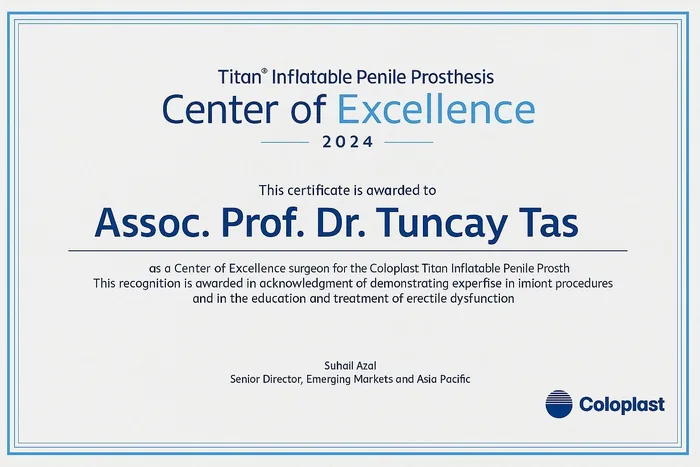
 Medically reviewed by Assoc. Prof. Dr. Tuncay Taş