
Medically reviewed by Assoc. Prof. Dr. Tuncay Taş
Losing a testicle leaves a gap felt long after the treatment ends. An implant fills it. In published surveys 97.7% of men rate the result excellent or good and 88.2% would decide the same again. Assoc. Prof. Dr. Tuncay Taş sizes each implant against the remaining testicle, so the match follows your anatomy.
Free Consultation
Our team responds within one business day, personally and confidentially.
What this asks of your time, before the detail.
Four numbers from peer reviewed patient surveys, each attributed to the study it comes from.
Rated satisfaction with their prosthesis as excellent or good, in a survey of testicular cancer survivors.
Revista Internacional de Andrologia, 2022
Would make the same decision again. Nearly all would recommend an implant to another man treated for cancer.
Revista Internacional de Andrologia, 2022
Felt it extremely important to be offered an implant at the time of orchiectomy, across 234 respondents.
BJU International, 2001
Is the share of men offered an implant at all, and only a third of those go ahead. Uptake sits far below satisfaction.
Asian Journal of Andrology, 2020
“We believe testicular implants should always be offered, leaving the final decision to the patient.”
Revista Internacional de Andrologia, 2022, questionnaire study of testicular cancer survivors
These are group results from published surveys, not promises. Outcomes vary with anatomy, the reason the testicle was lost, and how carefully the implant is sized.
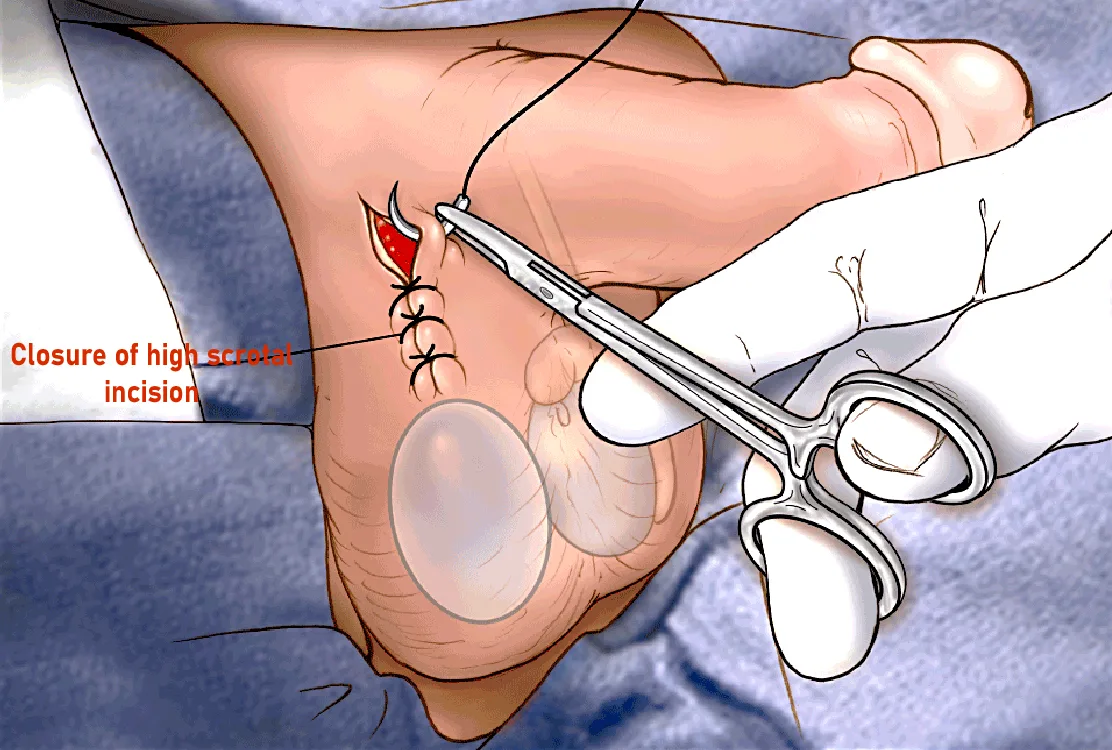
A testicular prosthesis is an implant shaped like a testicle, placed inside the scrotum on the side where one is missing. It restores shape, weight and symmetry. That is its entire job, and being clear about the limit of that job is the most useful thing this page can do.
It is not a working testicle. It produces no testosterone and no sperm. If you still have one healthy testicle, that one carries the whole load by itself. If both are gone, testosterone replacement is a separate treatment on its own terms, and the implant neither helps nor interferes with it.
What it changes is how the scrotum looks and feels. Men come because of changing rooms, because of a partner noticing, or because the asymmetry is the last reminder of an illness they would rather stop thinking about. In the Portuguese survey published in Revista Internacional de Andrologia in 2022, 59% rated a normal looking scrotum as important or extremely important to their self esteem.
The implant sits loose within the scrotum, held by the natural tissue rather than fixed rigidly, so it moves as a testicle moves. Modern implants are a silicone shell filled with silicone gel, and the softness of that gel is the difference between something that reads as a testicle and something that reads as a marble.
Two decisions are made before the operating theatre: what the implant is filled with, and what size it is. Neither is easy to change afterwards.
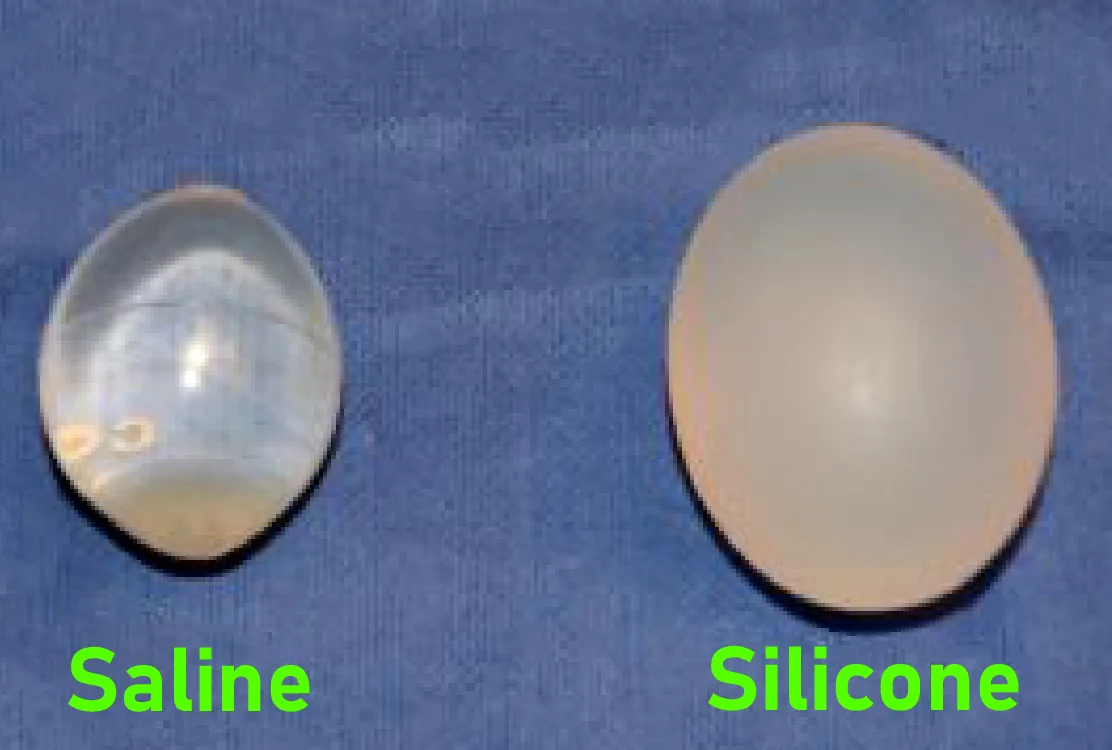
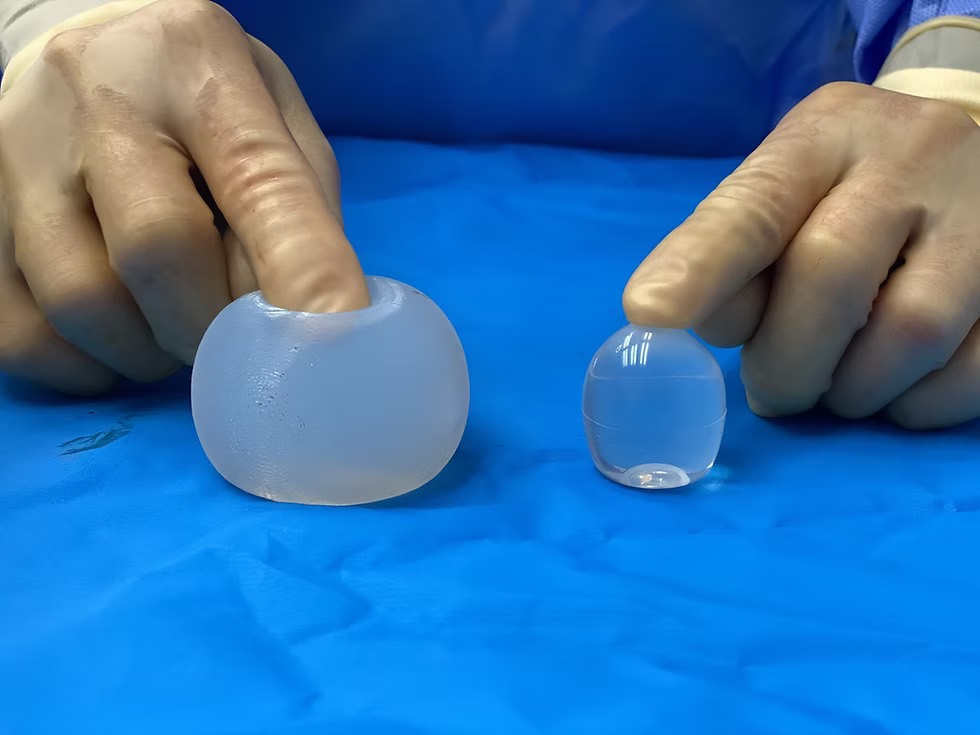
A soft silicone shell filled with gel, and the option most men choose. The gel yields under the fingers much as natural tissue does, and that single quality decides whether an implant feels convincing. The shell is sealed at manufacture, so there is nothing to fill or adjust later.
A silicone shell filled with sterile salt water. Its advantage is that the volume can be set during the operation rather than chosen from fixed sizes, which helps where the remaining testicle is an awkward size to match. What it gives up is feel: saline is thinner than gel and reads as slightly less like tissue.
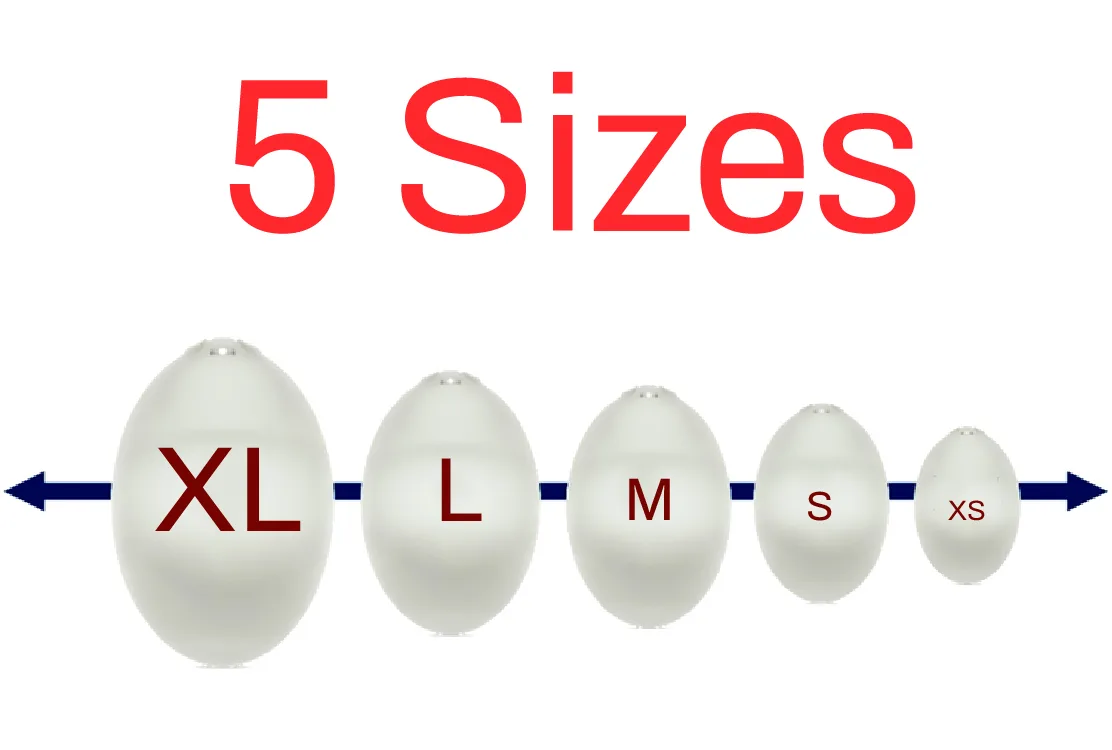
Size is the decision men underestimate and then think about most afterwards. The aim is not the largest that fits but the one that matches what is there.
Where one testicle remains it is measured and the implant chosen against it; where both are gone the choice is made against your build. Implants slightly too large sit higher in the scrotum and read as artificial. Correctly matched ones disappear.
The reason the testicle is missing changes the timing, not the operation.
The gap between how well this operation works and how often it happens is the striking finding in the literature. The 2020 review in Asian Journal of Andrology reports that only about two thirds of men undergoing orchiectomy are offered an implant, and roughly a third of those go ahead. A series of 475 consecutive germ cell tumour patients in BMC Urology in 2016, all offered a prosthesis before surgery, recorded 26.9% acceptance. The offer matters even when it is declined: 91% of the 234 respondents in the BJU International survey of 2001 called it extremely important.
Timing is the one real variable, and waiting costs nothing surgically: men who had an orchiectomy in their teens are routinely implanted in their thirties or later.
The assessment before surgery is short: general health and medication, particularly blood thinners; an examination to size the implant; and a conversation about what you expect, which matters more here than in most operations because the result is judged by eye and by hand. In the 2012 series in The Journal of Urology, the two complaints that predicted lower long term satisfaction were firm consistency and a high scrotal position, both easier to discuss beforehand than to correct afterwards.
A short operation with a small incision, under general anaesthesia or local anaesthesia with sedation.
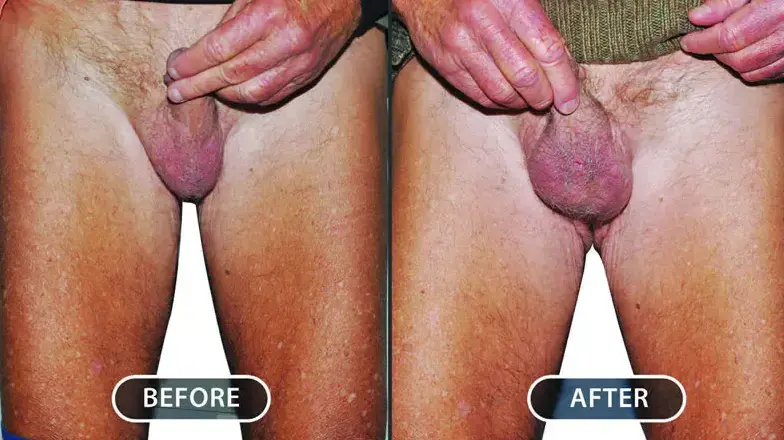
Recovery is straightforward as genital surgery goes: swelling and bruising for a week or two, soreness managed with ordinary painkillers. Supportive underwear rather than loose shorts makes the first fortnight considerably more comfortable.
The risks are those of any implant under skin. Infection matters most, because an infected implant usually has to be removed and replaced later rather than treated in place. A haematoma, a collection of blood in the scrotum, is the other early problem, and is why blood thinners are reviewed beforehand.
Putting a number on removal is hard because it depends on the population studied. A 2021 review in the International Journal of Transgender Health noted reported explantation rates spanning 0.6% to 30%, almost all driven by infection or extrusion, with the higher figures coming from neoscrotal reconstruction rather than implantation into an intact scrotum. At the other end, the survey of 40 men after orchiectomy in Urology in 2018 recorded no complications and no explantations, with 81% of implants in place beyond a year.
Later, the implant can migrate upwards, which looks wrong even when nothing is medically amiss, and very occasionally it erodes through the skin. In the 2022 Portuguese survey the complaints were texture in 45.5%, size in 18.1% and position in 15.9%, against overall satisfaction rated excellent or good by 97.7%. Those figures sit together rather than contradicting each other, and they are why sizing is laboured over at the consultation.
One expectation is worth setting precisely, because it separates a satisfied patient from a disappointed one. Under clothing and to a partner not deliberately examining it, the implant is not detectable. On direct handling most men can still tell: it is firmer and more uniform than natural tissue, with no cord structure behind it.
“The main complaints were firm consistency and high scrotal position, both of which were significantly associated with lesser satisfaction.”
The Journal of Urology, 2012, 86 men followed for a median of 6 years
Firmness was the commonest complaint in that series, reported by 70% of men, and it is why silicone gel is preferred over saline where matching allows. Men told this in advance are consistently happier than men promised an exact replica.
The result rests entirely on judgement: which implant, what size, how low it sits. Istanbul combines high case volume in genital reconstruction with accredited hospitals and costs that make the operation reachable privately.
Many men carry this for years without asking, either because nobody offered it during cancer treatment or because it felt too small a thing to raise. It is entirely reasonable to want it.
Where erectile function is also a concern, a penile implant is a separate operation that can be planned in the same visit, and men whose concern is size rather than absence should read about penile enlargement instead.
No. The implant is a sealed shell placed inside the scrotum to restore shape and symmetry. It produces no testosterone and no sperm.
If one testicle remains, it carries the hormonal and reproductive work on its own. If both are gone, testosterone replacement is a separate treatment, prescribed and monitored independently.
Close, but not identical. Under clothing and to a partner not deliberately examining it, the difference is not apparent. A modern silicone gel implant is soft and moves within the scrotum as a testicle does.
Firmness is the honest limitation and the commonest complaint in the surveys: 70% of men in The Journal of Urology in 2012 described the consistency as firm, and 45.5% in Revista Internacional de Andrologia in 2022 raised texture. Overall satisfaction in that 2022 study was still excellent or good for 97.7%.
On direct handling most men can still tell which side is the implant: it is slightly firmer and more uniform than natural tissue, and there is no cord structure behind it. Men who expect that are consistently more satisfied than men promised an exact copy.
It can, and after trauma or torsion that is often the simplest route. After removal for cancer many surgeons wait until the tissues settle and further treatment is finished. Being offered the choice matters either way: 91% of respondents in BJU International in 2001 called that offer extremely important, yet the 2020 review in Asian Journal of Andrology found only about two thirds of men are given it.
Delaying costs nothing surgically: men who had an orchiectomy as teenagers are routinely implanted decades later.
The operation takes about one to two hours, longer if both sides are done together, and it is usually a day case with no overnight stay.
Plan on four to five days in Istanbul: consultation, the operation, a rest day and a wound review before flying. Light activity resumes within a week; sport, cycling and sex at around four weeks.
There is a scar, but it is small and deliberately kept out of sight. The incision is made in the groin crease or at the top of the scrotum rather than on the scrotum itself, which hides the line in a natural fold and keeps the healing wound away from the implant. Scrotal and groin skin heal well, and the mark usually fades within a few months.
It is designed to be permanent and most are never touched again. There is no expiry date and no replacement interval. In the survey of 40 men after orchiectomy in Urology in 2018, no patient reported a complication and none had the implant removed.
Revision becomes necessary only if something goes wrong: infection, migration upwards in the scrotum, discomfort that does not settle, or dissatisfaction with the size. Careful sizing at the consultation removes the commonest cause.
Yes. Bilateral implants are placed in a single operation, whether the testicles were removed together, removed years apart, or never developed. Doing both at once makes matching easier, because the surgeon chooses a pair rather than copying an existing testicle.
Populations differ between these studies, which is why figures are attributed individually rather than averaged.
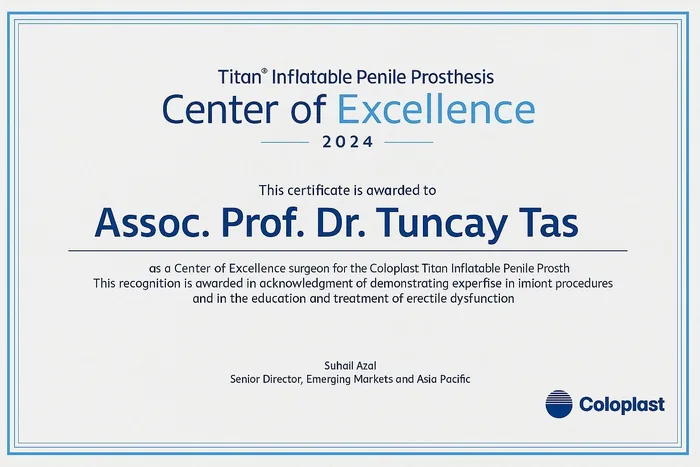
 Medically reviewed by Assoc. Prof. Dr. Tuncay Taş