
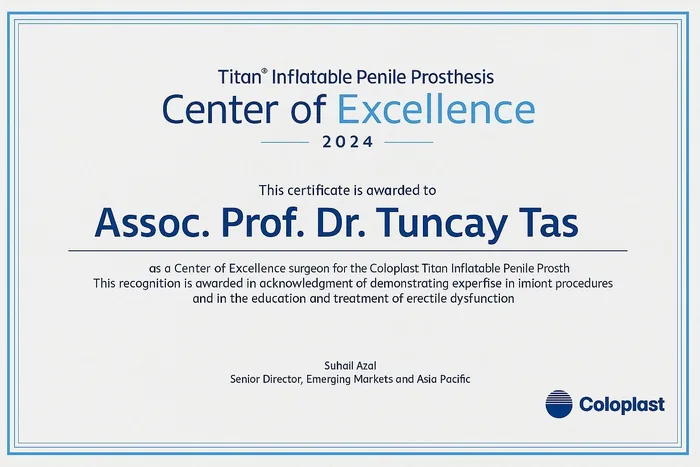
Medically reviewed by Assoc. Prof. Dr. Tuncay Taş
Azoospermia, no sperm in the ejaculate, does not always mean no sperm at all. Small pockets of tubules often keep working. Micro-TESE searches the testicle under an operating microscope to find them, and in men with non-obstructive azoospermia it finds sperm in roughly half of operations. Assoc. Prof. Dr. Tuncay Taş performs it in Istanbul, timed with your partner's IVF/ICSI cycle.
Free Consultation
Our team responds within one business day, personally and confidentially.
Micro-TESE (microdissection testicular sperm extraction) finds sperm directly inside the testicle when none reach the ejaculate. The surgeon examines the tubules at high magnification and removes only the wider, whiter ones that still make sperm.
It is designed for non-obstructive azoospermia, where the testicle itself produces very little sperm. It is most often recommended for:
If a blockage is the cause, a simpler retrieval or a vasectomy reversal is usually better. See male infertility treatment for the full diagnostic pathway.
What published studies show about finding sperm in non-obstructive azoospermia:
Operations in non-obstructive azoospermia in which sperm are found.
EAU Guidelines on Sexual and Reproductive Health
How much more often micro-TESE finds sperm than conventional TESE (52% vs 35%).
Bernie et al., Fertil Steril 2015
Sperm retrieval rate in men with Klinefelter syndrome.
Corona et al., Hum Reprod Update 2017
Chance with a complete AZFa or AZFb deletion, which is why genetic tests come first.
Hopps et al., Hum Reprod 2003
Hormone levels and testicle size do not reliably predict success, so a negative biopsy elsewhere does not rule micro-TESE out.
The right method depends on whether the testicle is making sperm.

A Targeted Search Under the Microscope
The testicle is opened fully and searched tubule by tubule at 15 to 25 times magnification. An embryologist checks each sample in theatre, so the search continues until sperm are found.

Small Random Samples of Testicular Tissue
Small biopsies are taken without a microscope. This works when production is normal, but in non-obstructive azoospermia it often misses the few areas making sperm.

Needle or Epididymal Retrieval When Sperm Are Trapped
When a blockage traps sperm, they can be drawn from the testicle (TESA) or epididymis (PESA, MESA). Quick and minimally invasive, but rarely useful when production is the problem.
Choose the cause closest to yours to see published retrieval rates.
Retrieval Estimator
About half of men with unexplained non-obstructive azoospermia have sperm found.
Ranges from published series and meta-analyses (EAU Guidelines; Corona et al. 2017; Hopps et al. 2003; Hsiao et al. 2011; Raman and Schlegel 2003). Educational only; your own outlook is assessed at consultation.
Most of these can be done at home before you travel, and the results reviewed remotely.
Stop any testosterone gel or injections well before surgery, as they switch off sperm production.
How a typical trip to Istanbul runs:
Swelling and bruising are expected; serious complications are uncommon.
Micro-TESE sperm are always used with ICSI, where one sperm is injected into each egg. There are two ways to plan it:
Fresh and frozen micro-TESE sperm give broadly similar fertilisation results.
Retrieval rates depend on the surgeon's microscope skills and on the lab beside the theatre, and Istanbul offers both at a fraction of Western private fees.
Assoc. Prof. Dr. Tuncay Taş explores the whole testicle methodically, with an embryologist in theatre, so the operation ends with a clear answer.
All-inclusive prices at Dr. Tas Clinic versus typical private fees abroad; your exact cost is confirmed after consultation.
| Procedure | Dr. Tuncay Taş Istanbul, Turkey | United Kingdom | United States | Europe |
|---|---|---|---|---|
| Micro-TESE Microsurgical testicular sperm extraction | $2,500 to $4,500 | £4,800 to £8,000 | $8,000 to $15,000 | €4,500 to €8,000 |
| Conventional TESE Testicular biopsy without a microscope | $2,000 to $3,000 | £3,200 to £4,800 | $5,000 to $8,000 | €3,000 to €5,000 |
| Sperm Freezing Storage of retrieved sperm for later ICSI | On request | £400 to £800 | $1,000 to $2,000 | €300 to €700 |
| IVF with ICSI Per cycle, for the partner | $3,000 to $4,500 | £5,500 to £8,000 | $15,000 to $25,000 | €5,000 to €8,000 |
In men with non-obstructive azoospermia, sperm are found in roughly 40 to 60% of operations. The chance depends heavily on the cause: it is higher after undescended testes or with an AZFc deletion, and close to zero with a complete AZFa or AZFb deletion.
Conventional TESE takes small random biopsies. Micro-TESE uses an operating microscope to pick out the tubules most likely to contain sperm, so it finds sperm more often while removing less tissue.
Most men stay four to six days: consultation, day surgery, then two or three days of rest and a wound check before flying. If fresh sperm is planned, the stay is timed around your partner's egg collection.
There is no pain during surgery, which is under general anaesthesia. Most men then have two to four days of aching, eased by simple painkillers, and return to desk work within a week.
The tissue is examined by a pathologist to explain why. A repeat is sometimes possible after six months or more, occasionally after hormone treatment. Donor sperm is not permitted in Turkey, so couples who would consider it plan that step abroad.
Yes. Any sperm not used on the day are frozen, so later IVF/ICSI cycles need no further operation.
Testosterone often dips for a few months after surgery and usually recovers within a year. Erections and sex drive are not directly affected, but men who started with low testosterone should have it rechecked at around six months.
 Medically reviewed by Assoc. Prof. Dr. Tuncay Taş