
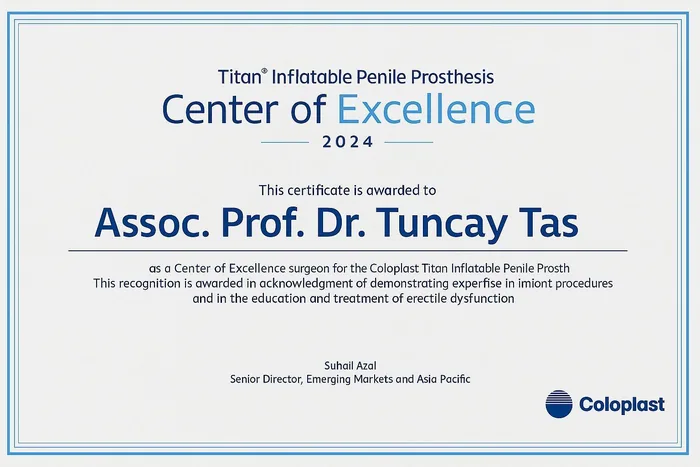
Medically reviewed by Assoc. Prof. Dr. Tuncay Taş
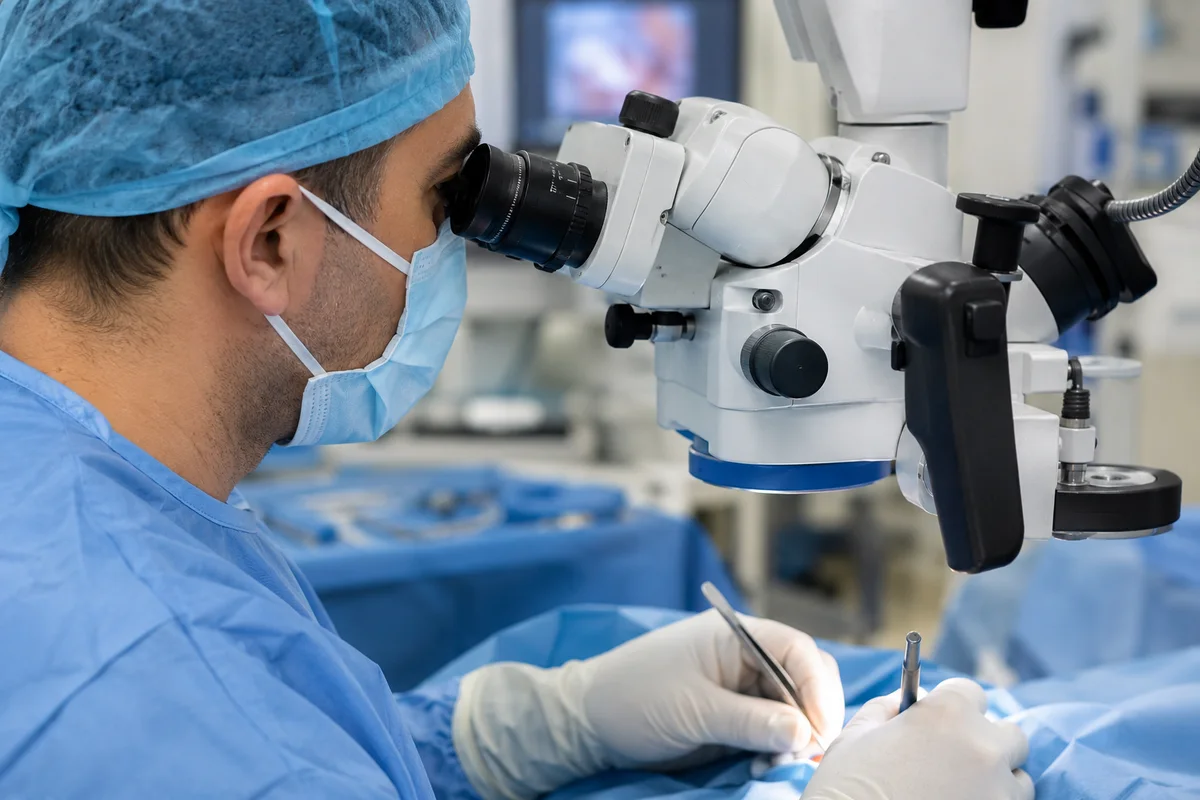
A varicocele is a cluster of swollen veins above the testicle that warms it and slows sperm production. Assoc. Prof. Dr. Tuncay Taş ties off only the faulty veins under an operating microscope through a 2 to 3 cm groin incision, sparing the artery and lymph vessels. The varicocele returns in just 1 to 2% of men, and most go home the same day.
Free Consultation
Our team responds within one business day, personally and confidentially.
A varicocele is a swelling of the network of veins above the testicle, much like a varicose vein in the leg. Faulty valves let blood flow back and pool, which warms the testicle and lowers the oxygen reaching it. Sperm production suffers as a result.
About 85% of varicoceles are on the left side, because of how the left testicular vein drains. They are graded on examination:
Most varicoceles cause no symptoms. When they do, the usual signs are a dull, dragging ache that worsens after standing, a soft swelling above the testicle, or one testicle becoming smaller.

Varicocele is the most common correctable cause of male infertility:
Of all men have a varicocele, most of them without any symptoms.
EAU Guidelines
Of men seen for infertility have one, rising to 70–80% for a second child.
EAU Guidelines
Natural pregnancy after microsurgical repair vs no treatment.
Abdel-Meguid et al., 2011
Recurrence after microscopic surgery, the lowest of any technique.
Cayan et al., 2009
A varicocele does not make every man infertile. Many fathers have one, which is why surgery is planned on semen results and symptoms, not on the finding alone.
Following EAU guidelines, surgery is advised when the varicocele is causing a problem:
If tests show no sperm at all, varicocele repair alone is rarely enough; see Micro-TESE surgery and our wider male infertility treatment options.
Every method aims to stop blood flowing back to the testicle. They differ in how often the varicocele returns and how often fluid builds up around the testicle (hydrocele).
| Method | Microscopic Subinguinal microsurgery | Laparoscopic | Open (Palomo) | Embolization |
|---|---|---|---|---|
| Success | 85–95% | 80–90% | 70–80% | 75–85% |
| Recurrence | 1–2% | 3–7% | 5–15% | 5–10% |
| Hydrocele | Under 1% | 5–10% | 5–15% | None |
| Recovery | 3–5 days | 5–7 days | 7–10 days | 1–2 days |
Without a microscope the artery and lymph vessels are hard to spare, which explains the higher hydrocele rates. Embolization avoids an incision but uses radiation and contrast, and fails technically in 10 to 15% of cases.
A short, day-case operation, planned around a confirmed diagnosis.
Answer three quick questions to see the usual next step and its cost in Turkey.
Surgery Checker
Microscopic varicocelectomy
Cost in Turkey: $2,000 to $3,500
A palpable varicocele with abnormal semen is the classic reason for repair.
Based on EAU guidance on varicocele treatment. Educational only; your treatment is decided after examination, Doppler ultrasound and semen analysis.
The operation takes one day; the weeks after it protect the result.
Sperm take about 72 to 90 days to develop, so results show between 3 and 6 months and can keep improving for up to a year.
The result depends on the surgeon's microsurgical skill, and Istanbul offers it within a short trip, at a realistic private cost.
Assoc. Prof. Dr. Tuncay Taş performs every varicocele repair under an operating microscope, never by eye alone, and treats both sides in one operation when needed.
All-inclusive prices at Dr. Tas Clinic in Istanbul against typical private fees abroad.
| Procedure | Turkey Dr. Tuncay Taş, Istanbul | United Kingdom | United States | Europe |
|---|---|---|---|---|
| Microscopic Varicocelectomy One side, subinguinal | $2,000 to $3,500Save up to 70% | £4,000 to £6,500 | $6,000 to $12,000 | €4,500 to €7,000 |
| Bilateral Varicocelectomy Both sides in one operation | $2,500 to $4,300Save up to 70% | £5,000 to £7,500 | $10,000 to $15,000 | €5,500 to €8,500 |
Turkey prices include the surgeon and anaesthesia fees, hospital stay, pre-operative tests and airport transfers. Your exact cost is confirmed after consultation.
Yes. The microscope lets the surgeon see and keep the testicular artery and lymph vessels, so hydrocele occurs in under 1% of men and damage to the testicle is very rare. Mild bruising and swelling for a few days are normal.
It is a day-case operation. Most men return to desk work in 2 to 3 days and light sport in 7 to 10 days. Sex can resume after 3 to 4 weeks, and heavy lifting and full training after 4 to 6 weeks.
Sperm parameters improve in about 70 to 80% of men, and 30 to 50% of couples conceive naturally within a year. Varicocele pain eases or goes in about 70 to 80% of men, and the varicocele returns in only 1 to 2%.
Microscopic varicocelectomy costs $2,000 to $3,500 in Istanbul, against $6,000 to $12,000 in the US and £4,000 to £6,500 in the UK. Your exact price is confirmed after consultation.
Sperm take about 72 to 90 days to develop, so improvement shows between 3 and 6 months and can continue for up to 12 months. The first semen analysis is done at 3 months.
Rarely. Recurrence is 1 to 2% after microscopic surgery, compared with 3 to 7% after laparoscopic surgery and 5 to 15% after open surgery without a microscope.
 Medically reviewed by Assoc. Prof. Dr. Tuncay Taş